A wedding in Venice: boats, acqua alta and what it really costs
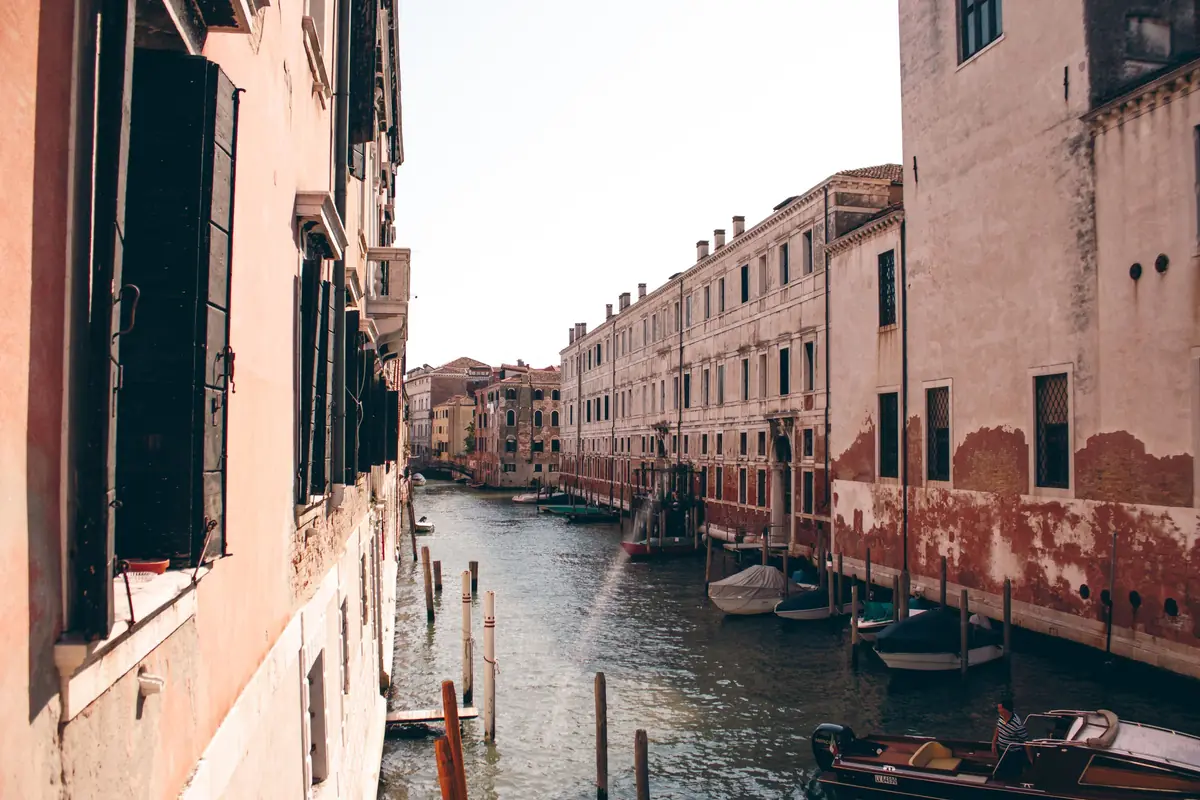
Venice has no roads. Every single thing — your guests, the flowers, the cake, the band's equipment — arrives by boat, and that is the line that breaks budgets.
Venice is the most photogenic wedding city in Europe and the one where budgets go wrong in the most predictable way. Not because anything is overpriced, but because of one structural fact that couples planning from abroad consistently underestimate.
There are no roads. Start there.
In the historic centre there is no car, no van, no taxi and no delivery truck. Your guests arrive by boat. The flowers arrive by boat. The cake, the chairs, the sound system, the photographer's lighting and the caterer's kitchen equipment all arrive by boat, and are then carried by hand, over bridges, with steps.
Every supplier prices that in. It is not a surcharge you can negotiate away; it is the cost of the city working at all.
What the boats actually cost
A private water taxi from the airport to the historic centre is commonly quoted somewhere in the region of €120 to €180 one way, and it carries a small group with luggage — not a coach party. The public waterbus is a couple of euros a head and takes an hour or more with suitcases, which is fine for you and less fine for eighty guests in formalwear.
Do the arithmetic before you fall in love with an island. Eighty guests from a hotel to a palazzo and back, in boats that hold eight to ten people, is something like twenty crossings. At a typical private-transfer rate that is a five-figure transport line on its own — larger, often, than the flowers.
There are cheaper structures. A single large motonave for a group transfer costs far less per head than a fleet of taxis. Choosing a venue within walking distance of the guest hotel removes the problem entirely. Both require deciding this early rather than late.
Acqua alta
The high-water season runs roughly from October to January, and it is driven by tide, wind and pressure rather than by rain.
Since 2020 the MOSE barriers have been raised to protect the city on high tides, and serious flooding in the centre is now far less frequent than it was. That is a genuine change and it is worth knowing. It is not, however, a guarantee for a specific date eighteen months out.
What to ask is simple and specific: what does this venue's ground floor do in acqua alta, has it flooded in the last five years, and what is the plan if the forecast is bad on the morning of the wedding? A palazzo whose entrance is at canal level has a different answer from one with three steps up.
Ceremony options
- Civil ceremony — the comune performs these in its own historic rooms, which are genuinely beautiful. They book up well ahead, carry a fee that varies by residency and by room, and the paperwork takes time. Start this early; it is the part with the least flexibility.
- Symbolic ceremony — no legal effect and no paperwork, so it can happen anywhere, including a garden or a boat. Many couples do the legal part at home and the real one here.
- Religious ceremony — possible, with the relevant church's own requirements and its own documentation, which is a separate process from the civil one.
The venue types, and what each one really means
- A palazzo on the Grand Canal — the image everyone has. Expensive, spectacular, and frequently with a strict noise curfew because neighbours live above and beside you.
- A private island — total control and a captive guest list, but every single person and object arrives and leaves by boat on a schedule you have to run.
- A hotel with a terrace or garden — much simpler logistics, because the guests are already there and so is the kitchen.
- The Lido — has roads, cars and space, costs considerably less, and is fifteen minutes by boat from San Marco. Consistently underrated.
Where Venice is genuinely worth it
For a small wedding — twenty to forty people — Venice is superb and the logistics stay manageable. Everyone fits in a few boats, one palazzo room is enough, and the city does the work that a hundred thousand euros of production would have to do elsewhere.
Above about eighty guests the transport arithmetic starts to dominate every other decision, and couples often find they are spending on boats what they wanted to spend on food. At that size, a villa on the Brenta Riviera — Palladian, forty minutes from Venice, with a car park — gives you most of the aesthetic and none of the freight problem.
Ask any Venice venue for a written transport plan for your guest count before you sign. If nobody can produce one, you have found the line item that will surprise you later.